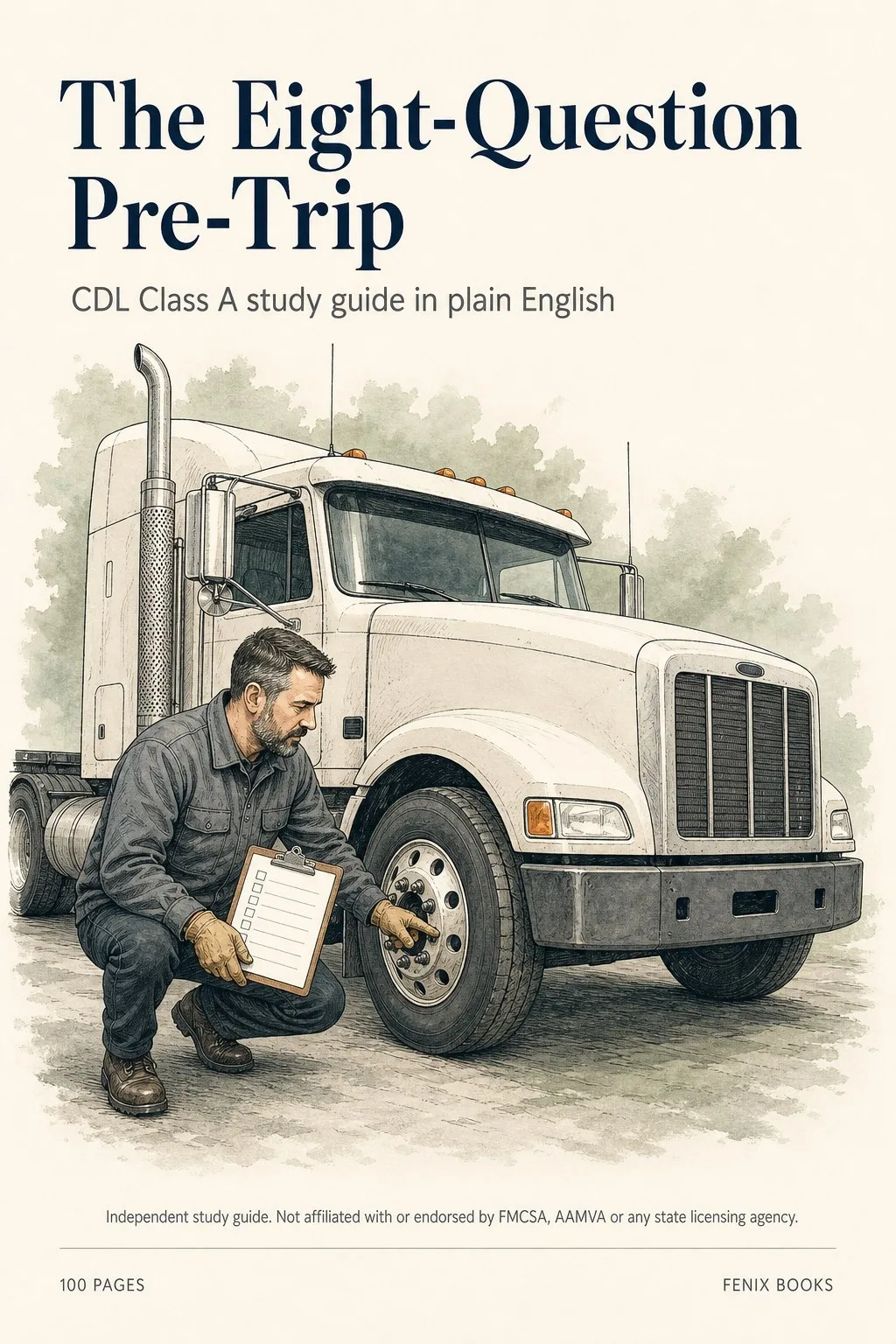
PDF guide for CDL Class A · Modernized checklist · 100 pages
Practice a complete inspection statement: name the component, describe its condition, and explain the check. The guide groups study pages under eight questions.
Protected checkout · PDF by email · 30-day guarantee
Independent study guide. Not affiliated with or endorsed by FMCSA, AAMVA or any state licensing agency.
Made to read on your phone while you study at the yard or at home before bed.


Swipe to see more · tap to zoom →
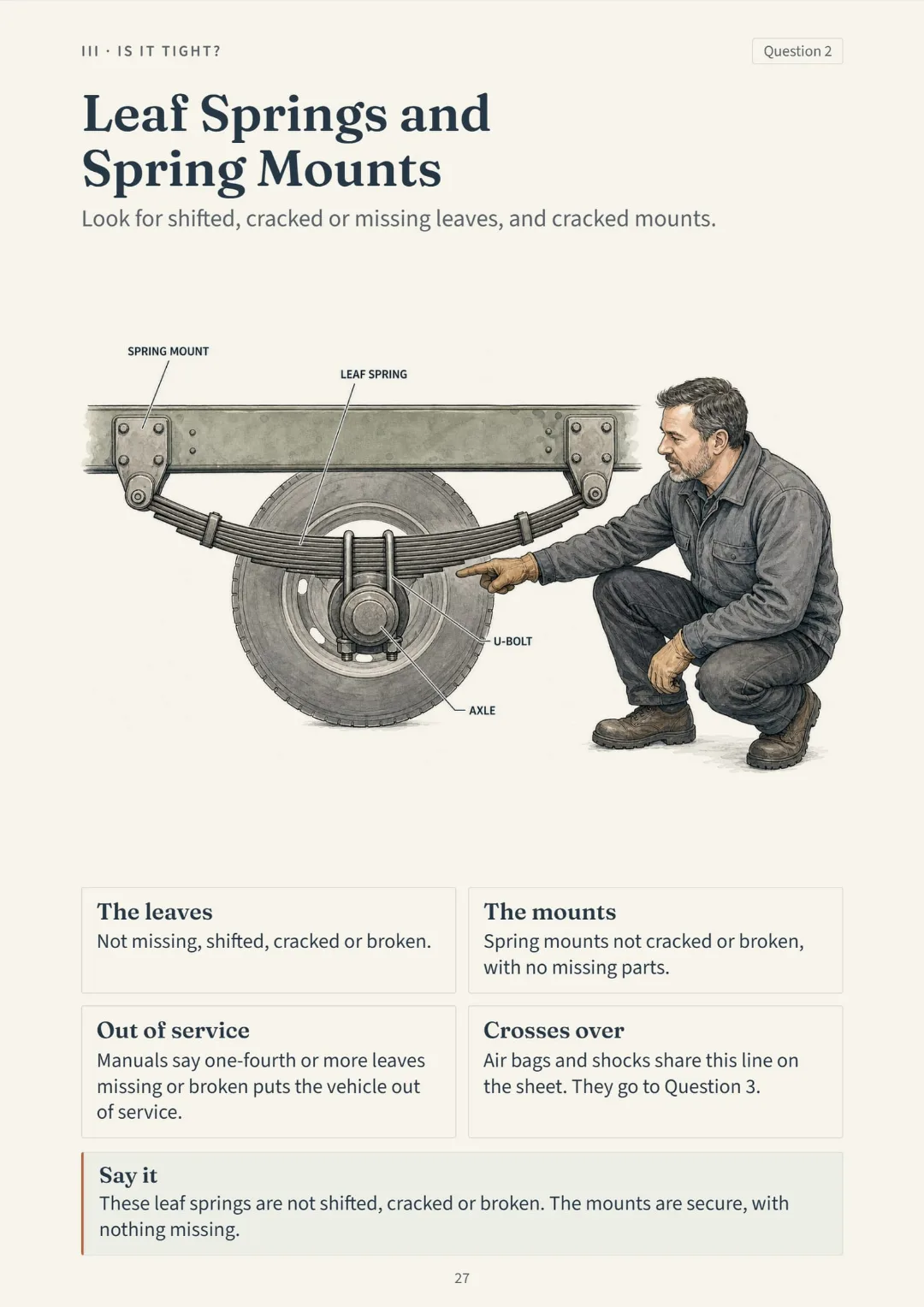
A practice answer needs more than a component name. With a leaf spring, for example, rehearse how you would describe shifted, cracked, or missing leaves. Then check the wording against the requirements for your test.
The pause between pointing and explaining is useful feedback. It identifies a check to rehearse with your instructor before moving to another area of the vehicle.

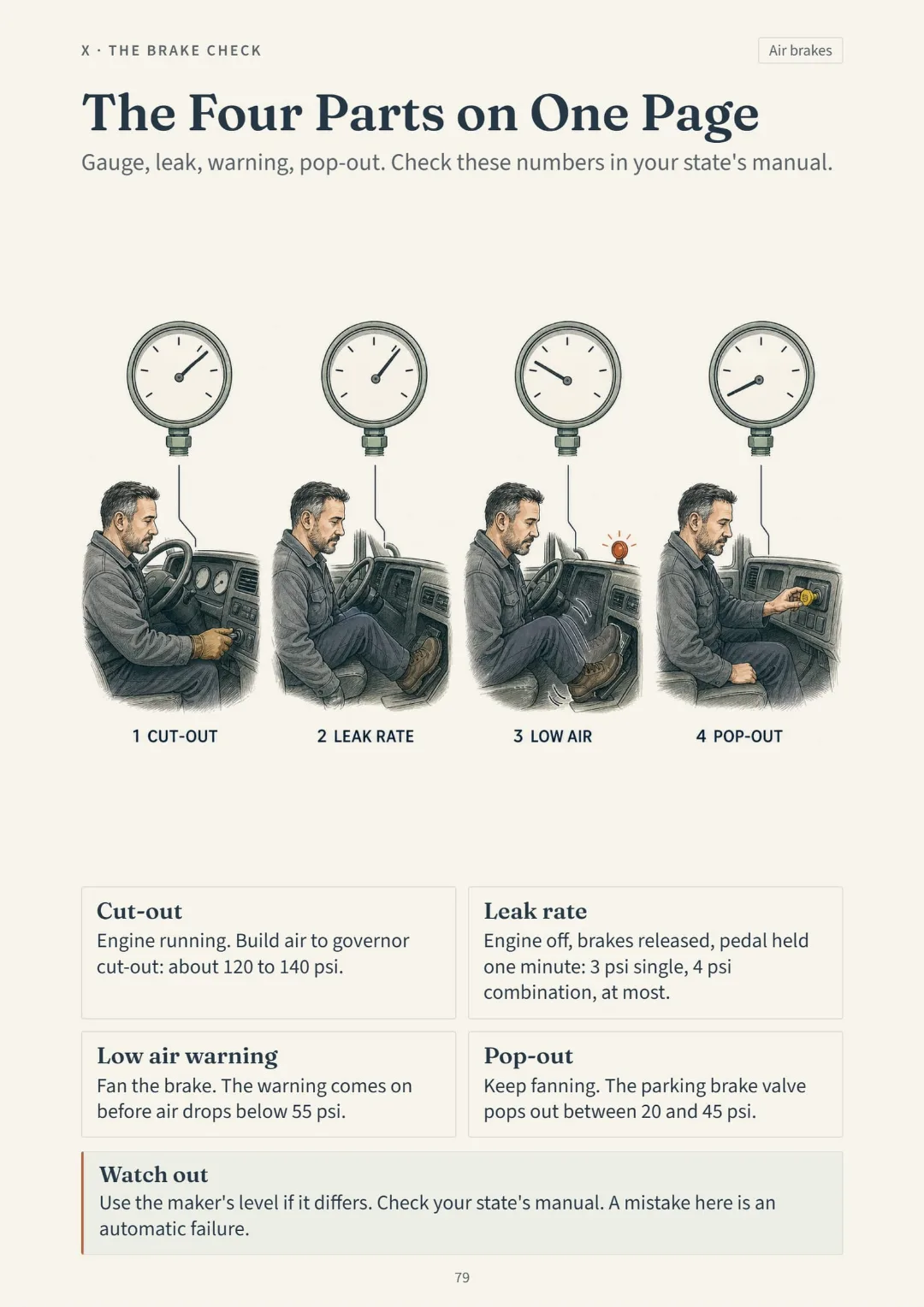
This page shows the entire air brake check in four parts: cut-out, leak rate, low-air warning, and pop-out. The usual numbers are printed right there. Check them against your state's manual, because that's what your examiner uses.
Another test fee
A failed pre-trip can mean a retest fee, depending on your state, and waiting for the next open slot. Every week without the CDL is a week you cannot drive.
Unfocused rehearsal
Repeating a full walk-around can hide the same weak answer. Mark the component you could not explain, review that page, and rehearse that check again.
The blank stare
Recognizing a part during study does not tell you whether you can explain its condition aloud. Find those gaps during rehearsal, when you can stop and ask for help.
Use each rehearsal to find the next answer that needs work.
Technical background on the suspension
49 CFR §393.207(c)

Use the page ranges below to choose a study area. The final sections connect the question groups to an inspection sheet and preparation for test day.
Which test version your state gives, how the eight questions work, and what you can hold during the test.
Fluids, steering, springs, frame, hoses, shocks, and belts: check six fluid levels under the hood with the same look every time.
Tires, rims, brakes, and slack adjusters: two tread-depth numbers, and you know every tire on the truck.
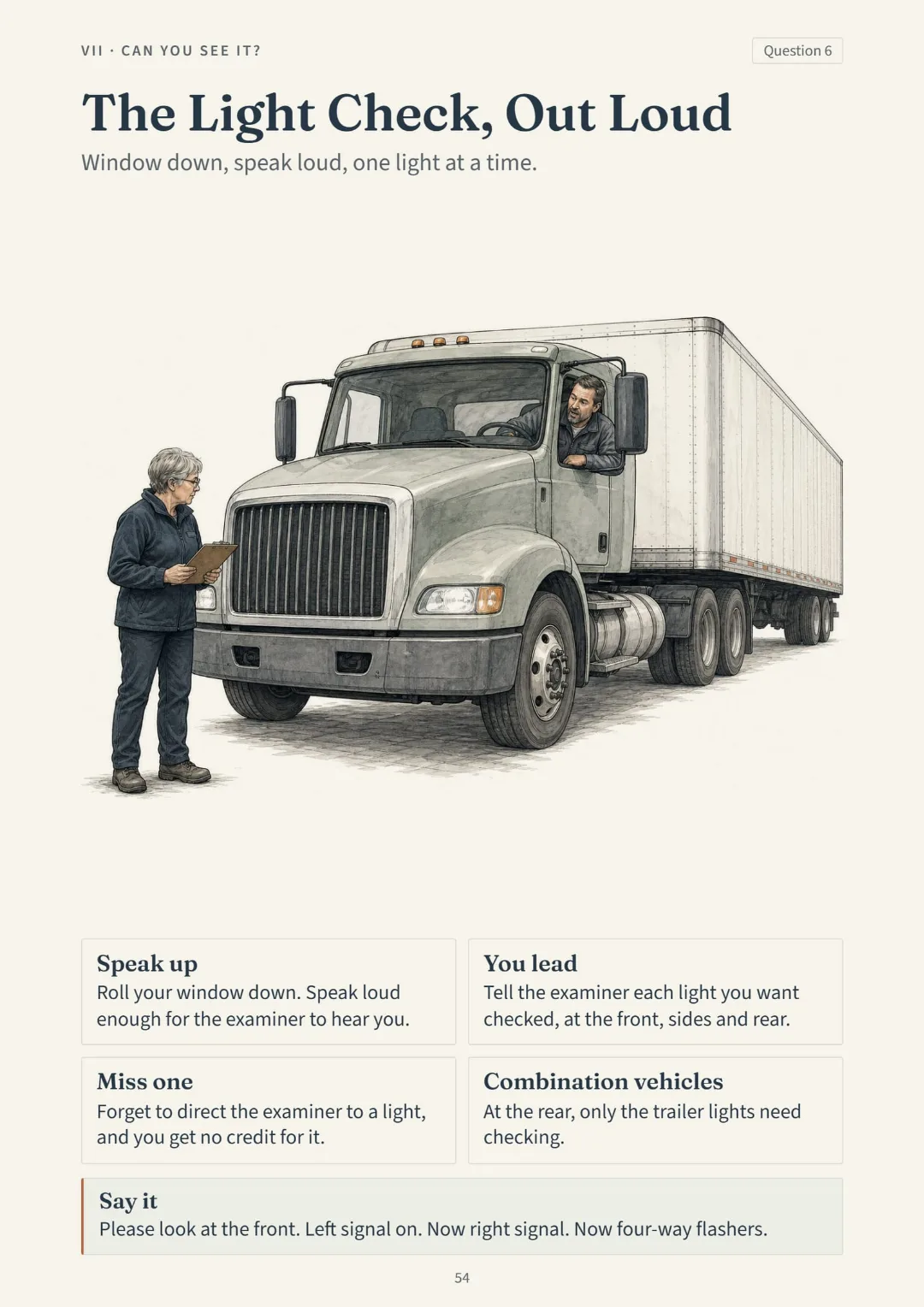
Lights, mirrors, coupling, fifth wheel, and cab check: call out each light one at a time, out loud, window down.
Four parts of the air brake check on one page, then zones, examiner commands, and what to do if you go blank.
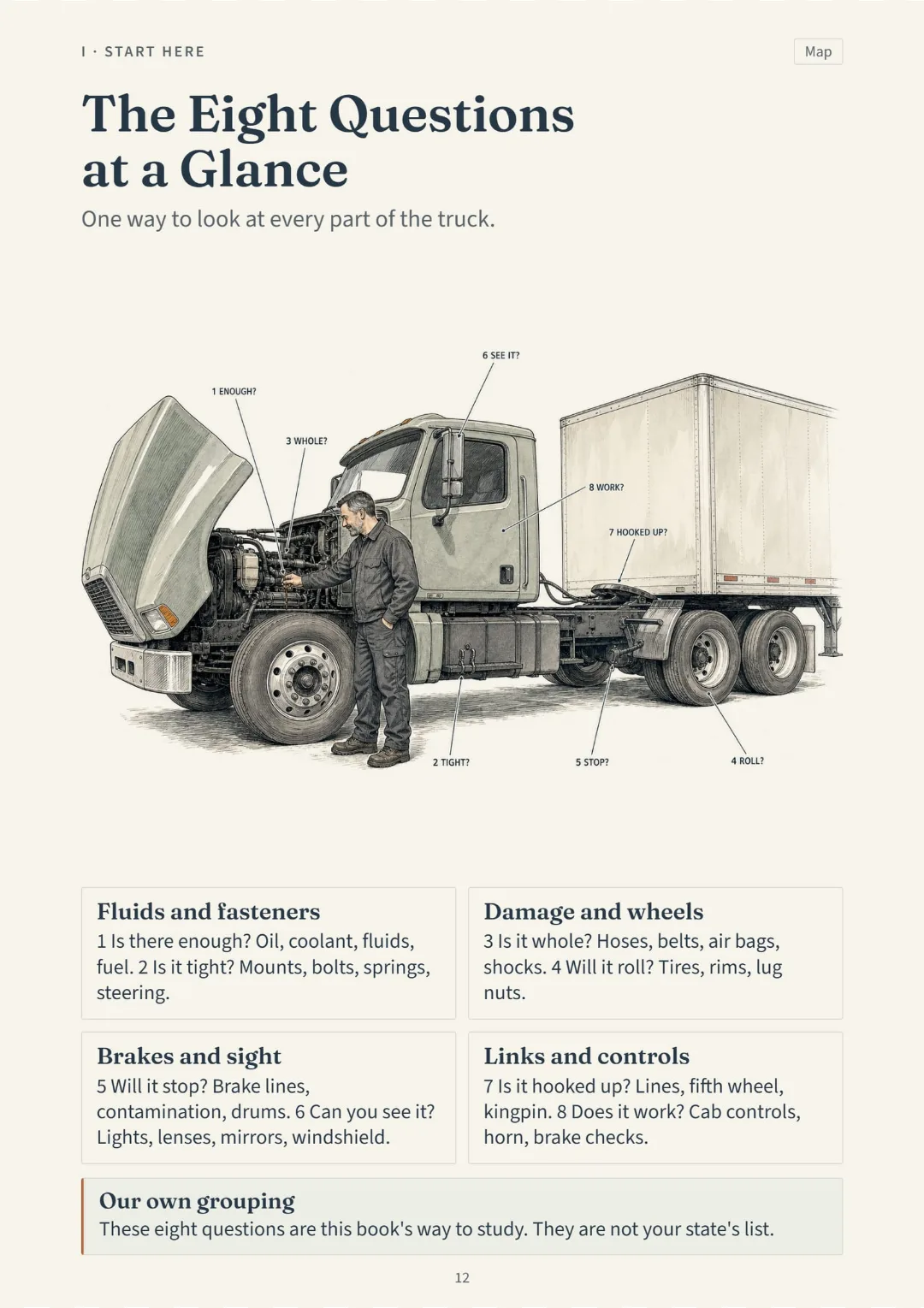
Each page covers one truck part, with one drawing and one line you can say out loud. Every part falls under one of eight plain questions: Is there enough? Is it tight? Is it whole? Will it roll? Will it stop? Can you see it? Is it hooked up? Does it work? These are a study grouping built for this book, not the state's checklist.

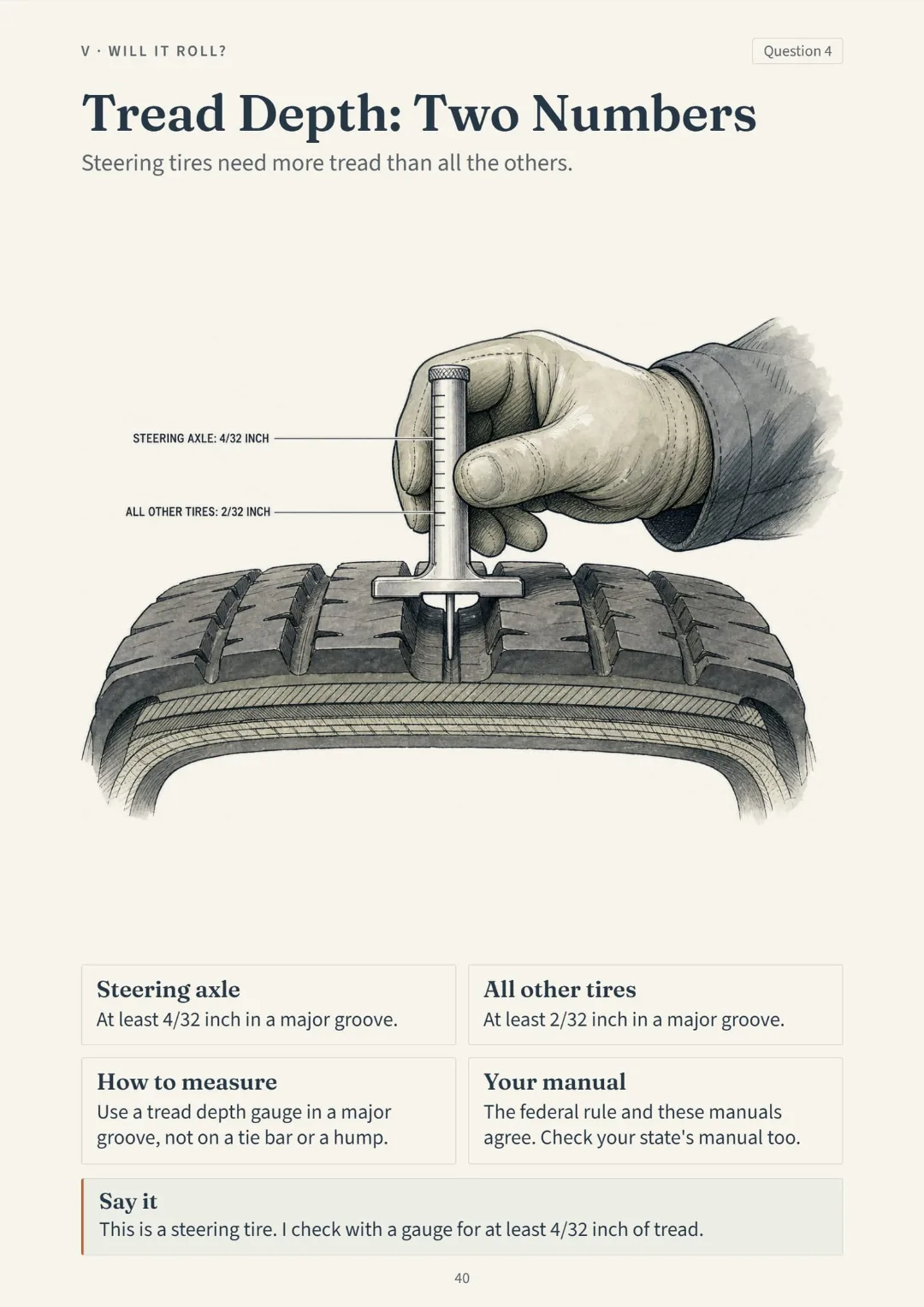
This page shows tread depth: 4/32 inch on steer tires, 2/32 inch on all the others. Two numbers, drawn side by side, with the tire right there.
Take the leaf spring. Your question is: Is it tight? You point at the leaves and say what you checked — shifted, cracked, or missing. The examiner gives credit when you name the part, touch it, and explain what you look for. No script to recite.
Record which checks you can explain and which need another supervised practice session.
How the eight questions work, which test version is yours, and what paperwork you can hold during the test.
Oil, coolant, power steering fluid, brake fluid, fuel, and DEF: check levels and spot leaks.
Steering box, battery, springs, tanks, and frame: everything that must stay tight.
Hoses, air bags, shocks, and belts: parts that must be whole, with no cracks or tears.
Tires, rims, lug nuts, hubs, and duals: what keeps the truck rolling.
Brake lines, chambers, slack adjusters, drums, and linings: what makes the truck stop.
Windshield, mirrors, wipers, and every light: what lets you and others see.
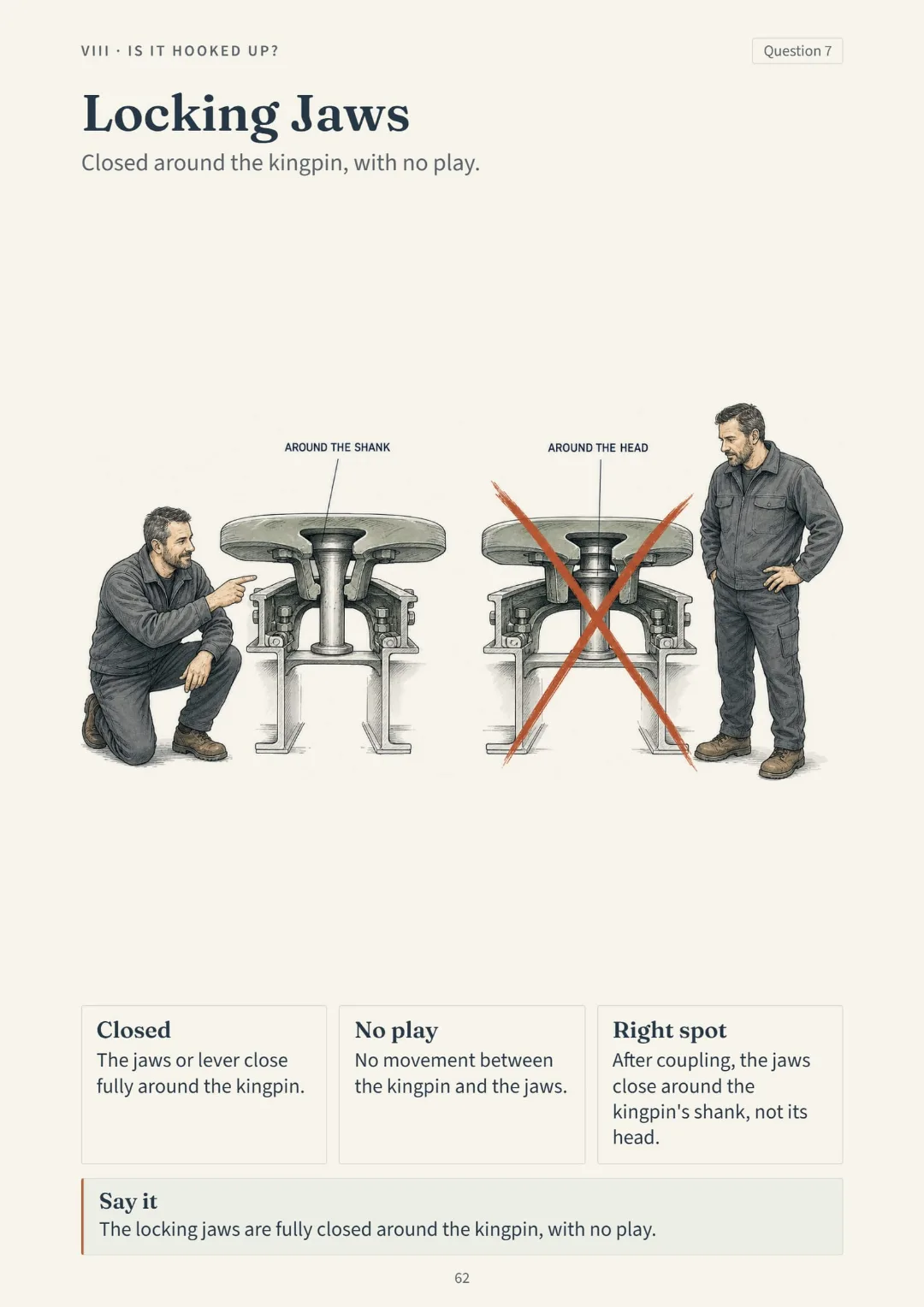
Air lines, glad hands, fifth wheel, kingpin, landing gear: what holds the tractor to the trailer.
Cab check, dash, emergency equipment, heater, horn, and service brake: what must work.
The air brake check in four parts: gauge, leak rate, low-air warning, and pop-out.
How to go from the inspection sheet to the eight questions, zone by zone.
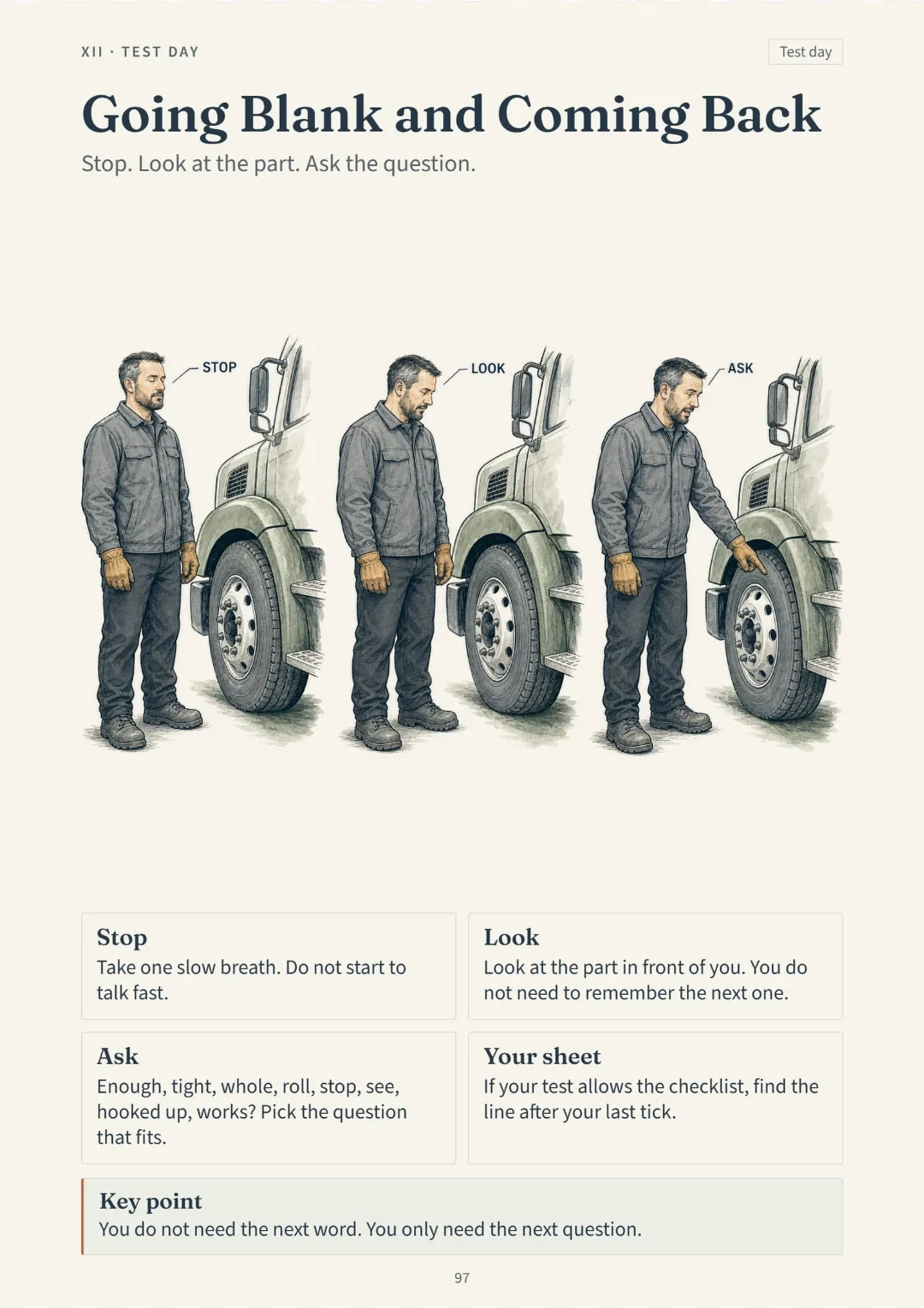
Examiner commands, going blank, parts with two names, and what to do if you fail.
The backing exercises for your test version, and what is scored on the road.
Print one sheet for each question and each zone, then practice out loud at home.
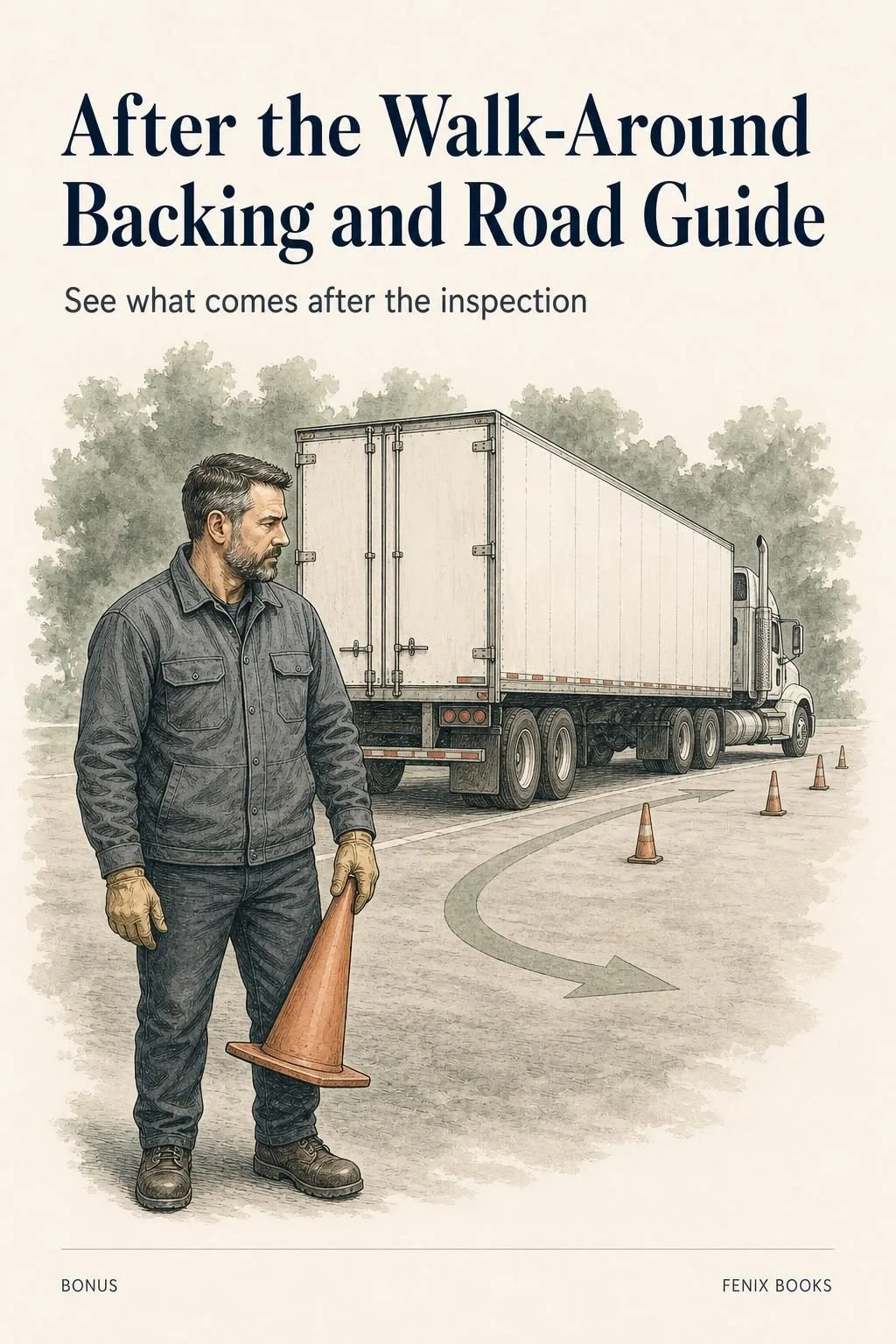
See what comes after the inspection: the backing exercises for your test version and what is scored on the road.

Print one sheet for each question and each zone, then practice out loud at home. These sheets stay home: they do not go to the test.
Digital book in PDF: it comes by email. Nothing is shipped on paper.
PDF by email: The purchase includes the inspection guide and both companion PDFs. Delivery uses the email address entered at checkout. There is one charge and no renewal.
Bring a specific question to your next lesson: which component can you identify but not yet explain? The illustrated pages give you material to review before supervised practice.
Use the feedback from your previous attempt to select pages for review. The sections on examiner commands and recovering from a pause support that preparation.
Choose a component and say its name and the relevant check aloud. Short English phrases support the rehearsal; the guide is in English and does not provide translation.
Digital book in PDF: it comes by email. Nothing is shipped on paper.
If the guide falls short during your first 30 days of study, you can request a full refund. Include what fell short in your message. Email hola@fenix-books.com.
The order is for PDF files, with no printed shipment. We use your checkout email address for delivery of the guide and its two companions; personal printing is allowed.
Yes. Every page is designed to be clear on a phone or tablet, or printed on paper.
Each part is drawn and named in short, plain English. One part on each page, with a line to practice out loud. No mechanic background needed. The book is in English only. The skills test is given in English, with no interpreter; the written test depends on the state.
The guide is organized for spoken rehearsal. Choose a check, practice describing it, then use the illustration and study phrase to review your answer. Keep your state's manual alongside it for the actual test requirements.
No. This is an independent study guide with drawings. No government agency produced or endorsed it. It is built on federal FMCSA rules and publicly available state CDL manuals. If anything differs from your state's manual, your state's manual has the last word.
No. Required training is set by federal and state rules. This book gives no certificate and does not count toward ELDT or any license requirement. It is study material you use alongside your program.
The book follows the modernized Class A checklist. The eight questions, the brake check and the plain phrases work on both versions, but the traditional list has more parts: add those from your state's manual. Check with your testing site which version they give.
Yes. One charge at checkout, and the PDFs are yours to keep. Nothing renews. You may see optional extras at checkout: you are only charged for the ones you add.
No. The book and the cards are for studying before the test, at home or at the yard. You carry the method in your head. Part 1 explains how to check what paperwork, if any, your state lets you hold during the test.
Pick a component from the sample pages and try explaining the check without reading the caption.
Use the answer you give to decide what to review next with your instructor.
The guide gives you pages to revisit between lessons. Your training, vehicle, and official test requirements remain the basis for the inspection.
US$ 29.90, paid once · 30-day guarantee · PDF by email
Questions? Write to hello@fenix-books.com
GET THE EIGHT-QUESTION PRE-TRIP · US$ 29.90Digital book in PDF: it comes by email. Nothing is shipped on paper.